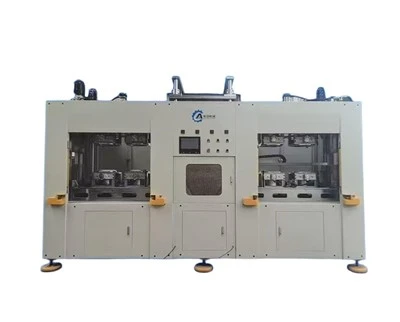
As a supplier of Servo Hot Plate Welders, I've had the chance to work closely with these machines and see their capabilities up close. But like any piece of equipment, they've got their limitations. Let's dive into what those are.


1. Material Compatibility
One of the big limitations of Servo Hot Plate Welders is material compatibility. These welders work by using a heated plate to melt the surfaces of two plastic parts, which are then pressed together to form a bond. However, not all plastics are created equal. Some plastics have a high melting point, while others have a low melting point. If you try to weld two plastics with very different melting points, it can be tough to get a good bond.
For example, if you're trying to weld a high - density polyethylene (HDPE) part to a polycarbonate part, the HDPE has a relatively low melting point compared to polycarbonate. The hot plate may heat up enough to melt the HDPE, but it might not be hot enough to properly melt the polycarbonate. This can result in a weak or incomplete weld. You can learn more about the general process of Hot Plate Welding to understand how material properties play a role.
2. Welding Complexity
Servo Hot Plate Welders are great for simple, flat - surfaced parts. But when it comes to complex geometries, they start to show their limitations. If a part has intricate shapes, undercuts, or multiple levels, it can be difficult to ensure that the entire surface of the part is evenly heated and welded.
Let's say you have a plastic part with a deep cavity. When using a hot plate welder, it can be hard to get the heat to reach the bottom of the cavity. As a result, the weld at the bottom of the cavity may be weaker than the rest of the weld. This can lead to structural integrity issues in the final product.
3. Cycle Time
Cycle time is another area where Servo Hot Plate Welders can be a bit of a challenge. The process of heating the hot plate, melting the plastic, and then cooling the welded part takes time. In high - volume production environments, this can slow down the overall production rate.
The heating and cooling times are determined by the type of plastic being welded and the size of the parts. For example, larger parts will take longer to heat and cool than smaller parts. If you're in a situation where you need to produce a large number of parts quickly, the cycle time of a Servo Hot Plate Welder may not be ideal. You can find more information about the equipment used in Hot Plate Welding Equipment to understand how it impacts cycle time.
4. Maintenance and Upkeep
Servo Hot Plate Welders require regular maintenance to keep them running smoothly. The hot plate itself needs to be cleaned regularly to prevent the build - up of plastic residue. Over time, the heating elements in the hot plate can wear out and need to be replaced.
In addition, the servo system that controls the movement of the hot plate and the parts needs to be calibrated and maintained. If the servo system is not working properly, it can lead to inconsistent welds. This maintenance can be time - consuming and costly, especially for small - to - medium - sized businesses.
5. Energy Consumption
These welders are energy - intensive machines. The hot plate needs to be heated to a high temperature to melt the plastic, and this requires a significant amount of energy. In today's world, where energy efficiency is a major concern, the high energy consumption of Servo Hot Plate Welders can be a drawback.
Not only does it increase the operating costs for the business, but it also has an environmental impact. If you're looking for a more energy - efficient welding solution, a Servo Hot Plate Welder may not be the best choice.
6. Weld Strength Variability
The strength of the weld created by a Servo Hot Plate Welder can vary depending on several factors. As mentioned earlier, material compatibility and proper heating are crucial for a strong weld. But even if these factors are optimized, there can still be some variability in the weld strength.
Factors such as the pressure applied during the welding process, the cooling rate, and the cleanliness of the parts can all affect the final weld strength. This variability can be a problem, especially in applications where consistent weld strength is critical, such as in the automotive or aerospace industries.
7. Limited Welding Area
Servo Hot Plate Welders have a limited welding area. The size of the hot plate determines the maximum size of the parts that can be welded. If you need to weld large parts, you may need to invest in a larger hot plate welder, which can be expensive.
Moreover, if you have parts with irregular shapes that are larger than the hot plate, it can be difficult to achieve a proper weld. This limitation can restrict the types of products that can be manufactured using a Servo Hot Plate Welder. You can explore more about the Welding Hot Plate to understand its size and capacity limitations.
Conclusion
Despite these limitations, Servo Hot Plate Welders are still a valuable tool in many industries. They offer a reliable way to weld plastic parts together, and with proper understanding of their limitations, you can work around them.
If you're considering using a Servo Hot Plate Welder for your production needs, it's important to weigh the pros and cons. If you have any questions or need more information about our Servo Hot Plate Welders, feel free to reach out to us. We're here to help you make the best decision for your business.
References
- General knowledge from working with Servo Hot Plate Welders in the industry.
- Industry reports on plastic welding technologies.