

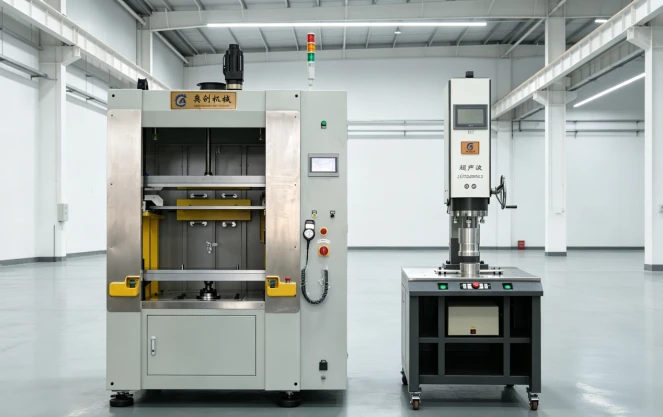
The two main types of plastic welding equipment-hot plate welders and ultrasonic welders-cover nearly all plastic welding applications. However, 80% of procurement mistakes in the industry stem from a failure to distinguish between the appropriate applications for these two types of equipment: using hot plate welders for small parts wastes production capacity, while using ultrasonic welders for large parts leads to constant rework, unnecessarily increasing material and labor costs. Below, we present a comprehensive, in-depth comparison across five key dimensions-principles, materials, workpieces, costs, and operations and maintenance-so you can avoid these selection pitfalls once and for all.
First, their operating principles are worlds apart. Ultrasonic welders rely on high-frequency vibrations at 15K or 20K to generate heat through instantaneous friction at the plastic contact surfaces, a process known as dynamic vibration welding; hot plate welders rely on heated plates to directly conduct heat and melt the material, operating statically without vibration throughout the process-a method known as constant-temperature hot-melt welding. These differences in principle directly determine the applicability limits of each machine.
Second, there are differences in material compatibility. Ultrasonic welders are suitable for rigid plastics such as ABS, PS, and PC, offering fast welding speeds and an aesthetically pleasing finish; however, they are inherently incapable of welding soft or semi-crystalline plastics like PP, PE, and nylon. These materials have low molecular activity, and the vibrations cannot effectively fuse the molecules, resulting in 100% failed welds. In contrast, hot plate welders can handle all thermoplastic materials-whether soft or hard, or glass-fiber-reinforced-and can weld them reliably, offering maximum material compatibility.
Third is workpiece size compatibility. Ultrasonic welders are suitable for small, thin-walled, precision components with intricate geometries-such as plastic housings, small latches, and small filter cartridges-with welding times of just 0.3–1 second, making them ideal for high-speed mass production of small parts; However, when dealing with large components, long weld seams, or irregularly shaped curved parts-such as automotive headlights, radiators, plastic pallets, and large home appliance housings-ultrasonic molds cannot conform to curved surfaces, and the vibrations can crack the internal precision structures of the workpiece, rendering the method completely unusable. Hot plate welders have no size restrictions on workpieces and can accommodate custom-made oversized molds and irregularly shaped contour molds, making them ideal for handling all types of large, non-standard workpieces.
Fourth is weld sealing and strength. Ultrasonic welds are relatively narrow and generally have poor airtightness, making them unsuitable for waterproof or pressure-bearing parts; hot plate machines produce complete, seamless fusion surfaces with waterproofing up to IP67 and strong pressure resistance, making them suitable for components requiring sealing and pressure resistance, such as radiators, oil reservoirs, and automotive headlights.
Fifth is procurement and operational costs. Ultrasonic equipment has a relatively high unit price; vibration causes rapid mold wear, resulting in high long-term operational costs and significant workshop noise. Servo-driven hot plate machines, on the other hand, are precise and stable, with low long-term operational costs and failure rates. Their molds are durable, and they operate quietly, making them suitable for high-volume, long-term production.
Finally, here's a mnemonic for selecting the right equipment: For small, hard parts and ultra-high production speeds, choose ultrasonic welding; for large, soft parts, sealing and pressure resistance, irregular shapes and curved surfaces, and PP/PE materials, choose a hot-plate machine without hesitation. By selecting equipment based on your specific products, you can ensure a high yield rate while maximizing control over equipment investment costs.


