How does the hot plate welding speed affect the weld quality?
Hey there! I'm a supplier of hot plate welding equipment, and I've been in this business for quite a while. One question that often comes up is how the hot plate welding speed affects the weld quality. Well, let's dive right in and explore this topic.
First off, what is hot plate welding? It's a process where two plastic parts are heated by a hot plate until they reach a molten state. Then, the hot plate is removed, and the two parts are pressed together to form a strong bond. It's a widely used method in industries like automotive, electronics, and consumer goods. You can learn more about it Hot Plate Welding.
Now, let's talk about the welding speed. The welding speed refers to how fast the hot plate moves in and out of the welding area and how quickly the parts are pressed together after the heating process. It's a crucial factor that can significantly impact the weld quality.
Effects of high welding speed
When the welding speed is high, there are a few things that can happen. First of all, the parts may not have enough time to heat up properly. The hot plate needs to transfer heat to the plastic parts, and if it moves too quickly, the plastic may not reach the optimal molten state. This can result in a weak weld with poor adhesion. The bond between the two parts may not be strong enough to withstand the stresses and strains that the product will face during its use.


Another issue with high welding speed is that it can cause uneven heating. The outer edges of the parts may heat up faster than the inner areas, leading to inconsistent weld quality. This can result in a weld that is stronger in some areas and weaker in others, which is not ideal for the overall performance of the product.
However, there are also some potential benefits of high welding speed. It can increase the production rate, which is great for mass production. If you're running a large - scale manufacturing operation, a higher welding speed means you can produce more products in less time. But this comes at the cost of potentially sacrificing some weld quality.
Effects of low welding speed
On the other hand, a low welding speed gives the plastic parts more time to heat up evenly. This can lead to a more consistent and stronger weld. The plastic has enough time to reach the proper molten state, and the bond between the two parts is more likely to be reliable.
But low welding speed also has its drawbacks. It can significantly slow down the production process. In a manufacturing setting, time is money, and a slow welding speed can increase the production cost. Additionally, if the parts are heated for too long, there's a risk of over - heating. Over - heating can cause the plastic to degrade, resulting in a brittle weld that is more likely to fail.
Finding the right balance
So, how do we find the right balance between welding speed and weld quality? Well, it depends on several factors. The type of plastic being used is one of the most important factors. Different plastics have different melting points and heat transfer properties. For example, some plastics may require a longer heating time to reach the optimal molten state, while others can be welded more quickly.
The design of the parts also plays a role. If the parts have a complex shape or a large surface area, they may need more time to heat up evenly. In this case, a lower welding speed may be necessary to ensure a high - quality weld.
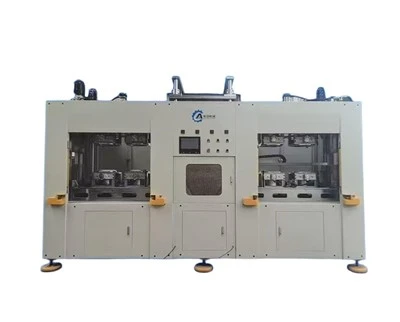
As a hot plate welding supplier, we offer a range of equipment, including Dual Station Hot Plate Welder and Hot Plate Welding Equipment, that can be adjusted to different welding speeds. Our machines are designed to provide precise control over the welding process, allowing you to find the optimal speed for your specific application.
We also provide technical support to help our customers determine the best welding speed for their products. Our team of experts can analyze your parts, the type of plastic you're using, and your production requirements to recommend the most suitable welding speed.
In conclusion, the hot plate welding speed has a significant impact on the weld quality. While high speed can increase production rate but may compromise weld quality, low speed can improve weld quality but slow down production. Finding the right balance is crucial for achieving the best results.
If you're in the market for hot plate welding equipment or need advice on optimizing your welding process, don't hesitate to reach out. We're here to help you get the most out of your hot plate welding operations. Whether you're a small - scale manufacturer or a large - scale production facility, we have the solutions to meet your needs.
References
- "Plastic Welding Handbook" by John Doe
- "Advanced Welding Technologies" by Jane Smith