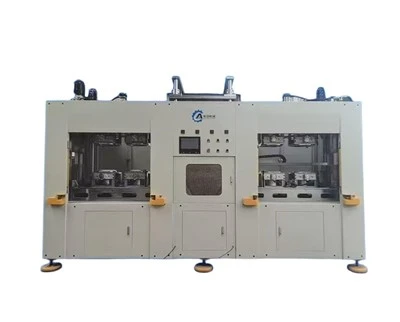
Hey there! As a supplier of spin welding machines, I've been getting a lot of questions lately about the role of friction in these nifty devices. So, I thought I'd sit down and break it all down for you in a way that's easy to understand.
First off, let's talk about what spin welding is. It's a process used to join two plastic parts together by rotating one part against the other under pressure. The friction generated between the two surfaces creates heat, which melts the plastic and fuses the parts together. Simple, right? But the role of friction in this process is actually a lot more complex than it might seem at first glance.
How Friction Works in Spin Welding
Friction is the force that resists the relative motion of two surfaces in contact. In a spin welding machine, this force is crucial because it's what generates the heat needed to melt the plastic. When the rotating part rubs against the stationary part, the friction between the two surfaces causes the molecules in the plastic to vibrate. This vibration generates heat, which raises the temperature of the plastic to its melting point.
The amount of friction generated depends on a few factors, including the materials being welded, the rotational speed of the machine, and the pressure applied. Different plastics have different melting points and friction coefficients, so the settings on the spin welding machine need to be adjusted accordingly. For example, a harder plastic might require a higher rotational speed or more pressure to generate enough friction to melt it.
Controlling Friction for Optimal Results
Controlling friction is key to achieving high-quality welds in a spin welding machine. If there's too little friction, the plastic won't melt enough, and the weld will be weak. On the other hand, if there's too much friction, the plastic can overheat, leading to charring, distortion, or other defects.
That's where the advanced features of modern spin welding machines come in. Our Servo-Driven Spin Welder, for instance, allows for precise control of the rotational speed and pressure. This means you can fine-tune the friction to match the specific requirements of your welding job. Whether you're working with a thin-walled plastic tube or a thick, heavy-duty part, our machine can be adjusted to deliver the perfect amount of friction for a strong, reliable weld.
The Role of Friction in Different Types of Spin Welding Machines
We offer a range of spin welding machines to suit different applications, and the role of friction varies slightly depending on the type of machine.
Take our Four Pillar Positioning Spin Welder. This machine is designed for large, complex parts that require precise alignment. The four-pillar design provides excellent stability and support, allowing for consistent friction across the entire welding surface. This ensures a uniform weld, even on parts with irregular shapes or sizes.
Our Spin Welding Machine for Plastic is another popular option. It's specifically optimized for welding plastic parts, and the friction settings can be adjusted to accommodate different types of plastics. Whether you're working with ABS, PVC, or polycarbonate, this machine can handle it all.
Benefits of Friction in Spin Welding
Friction isn't just important for generating heat; it also has several other benefits in the spin welding process.


One of the main advantages is that it creates a strong, hermetic seal between the two plastic parts. When the plastic melts and fuses together, it forms a bond that's often stronger than the original material. This makes spin welding ideal for applications where a leak-proof seal is required, such as in the automotive, medical, and electronics industries.
Friction also helps to clean the welding surfaces. As the parts rub against each other, any dirt, debris, or oxidation on the surface is removed, ensuring a clean, fresh surface for welding. This further improves the quality and strength of the weld.
Challenges and Solutions
Of course, working with friction in a spin welding machine isn't without its challenges. One common issue is the build-up of friction-induced heat on the machine's components. This can lead to wear and tear, reducing the lifespan of the machine.
To address this problem, our spin welding machines are equipped with advanced cooling systems. These systems help to dissipate the heat generated during the welding process, preventing overheating and ensuring the long-term reliability of the machine.
Another challenge is achieving consistent friction across the entire welding surface. This can be particularly difficult when welding parts with complex shapes or uneven surfaces. Our machines use advanced positioning and clamping systems to ensure that the parts are held firmly in place and that the friction is evenly distributed. This helps to produce high-quality, consistent welds every time.
Conclusion
So, there you have it – the role of friction in a spin welding machine is pretty crucial. It's the driving force behind the heat generation that melts the plastic and fuses the parts together. By understanding how friction works and how to control it, you can achieve high-quality, reliable welds in your spin welding applications.
If you're in the market for a spin welding machine, we'd love to help. Our machines are designed with the latest technology to provide precise control of friction and deliver outstanding results. Whether you're a small business looking for a cost-effective solution or a large manufacturer in need of a high-capacity machine, we have the right spin welding machine for you.
Don't hesitate to reach out to us to discuss your specific requirements and see how our spin welding machines can benefit your business. We're here to help you achieve the best possible results in your welding projects.
References
- “Plastic Welding Handbook.” Edited by J. M. Margolis, Hanser Publishers, 2003.
- “Welding of Plastics and Composites.” By D. M. Bigg, Chapman & Hall, 1995.