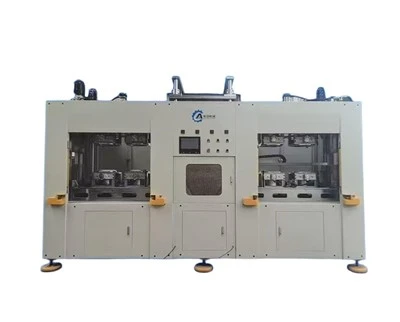
Let's dive right into the topic of what the surface finish of welded parts by a spin welding machine is. As a spin welding machine supplier, I've seen firsthand how this technology can make a huge difference in the manufacturing world, especially when it comes to getting that perfect surface finish on welded components.
Understanding Spin Welding
First off, let's quickly go over what spin welding is. Spin welding is a process where two plastic parts are joined together. One part is held stationary while the other is rotated at high speed. Pressure is then applied, and the friction generated between the two parts creates heat. This heat melts the plastic at the joint interface, and when the rotation stops and the parts cool down, they're permanently bonded.
The surface finish of the welded parts can vary quite a bit, and it depends on a bunch of factors. These factors include the type of plastic being welded, the settings on the spin welding machine, and even the design of the parts themselves.
Factors Affecting Surface Finish
Type of Plastic
Different plastics behave differently during the spin welding process. For example, some plastics like polypropylene and polyethylene are relatively easy to weld and can result in a smooth surface finish. They flow nicely when melted under the friction heat, and with the right welding parameters, you can get a clean, seamless joint.
On the other hand, engineering plastics such as polycarbonate or nylon can be a bit more challenging. These plastics have higher melting points and different flow characteristics. They might require more precise control of the welding speed, pressure, and time to achieve a good surface finish. Sometimes, you might end up with a slightly rougher surface or some visible signs of melting, like small bumps or ridges, if the process isn't optimized.
Machine Settings
The settings on your spin welding machine play a crucial role in determining the surface finish. The rotational speed is one of the most important factors. If the speed is too high, it can cause excessive melting, which might lead to flash or a rough surface. Flash is the excess plastic that squeezes out of the joint during welding.
The pressure applied during the welding process also matters. Too much pressure can force the melted plastic out unevenly, creating an irregular surface. On the other hand, if the pressure is too low, the bond might not be strong enough, and the surface might look wavy or incomplete.
The welding time is another key variable. If the welding time is too short, the plastic might not melt sufficiently, resulting in a weak joint with a poor surface finish. If it's too long, there's a risk of over - melting and damaging the parts.
Part Design
The design of the parts being welded can have a big impact on the surface finish. For instance, the shape of the joint area is important. A well - designed joint with proper mating surfaces can help ensure an even distribution of heat and pressure during welding. This leads to a better - looking and more reliable weld.
If the parts have complex geometries or thin walls, it can be more difficult to achieve a smooth surface finish. The heat distribution might be uneven, and there can be more stress concentrations during the welding process.
Surface Finish Qualities
Smoothness
One of the main goals when it comes to the surface finish of welded parts is smoothness. A smooth surface is not only aesthetically pleasing but can also be important for functional reasons. For example, if the welded parts are going to be in contact with other components, a smooth surface can reduce wear and tear and improve the overall performance of the assembly.
To achieve a smooth surface finish, you need to fine - tune the machine settings based on the type of plastic and part design. This might involve some trial and error, but with experience, you can get consistently good results.
Seam Integrity
Another important aspect of the surface finish is the integrity of the seam. A well - welded joint should have a continuous and strong seam. The seam should be free of cracks, voids, or other defects. If there are any defects in the seam, it can weaken the bond between the parts and reduce their overall strength and durability.
Cosmetic Appearance
In many applications, the cosmetic appearance of the welded parts is important. This is especially true for consumer products where the welded areas are visible. A good surface finish can enhance the product's appeal and give it a high - quality look.
Our Spin Welding Machines
As a spin welding machine supplier, we offer a range of machines that are designed to provide excellent surface finishes on welded parts. Our Spin Welding Machine for Plastic is suitable for a wide variety of plastic materials. It allows for precise control of the welding parameters, so you can achieve the perfect surface finish for your specific application.
We also have the High - End Positioning Spin Welder. This machine offers high - precision positioning, which is crucial for getting consistent and high - quality welds. With accurate positioning, you can ensure that the heat and pressure are evenly distributed, resulting in a smooth and reliable surface finish.
For those looking for advanced technology, our Servo - Driven Spin Welder is a great option. The servo - driven system provides greater control over the rotational speed and torque, allowing for more precise and customizable welding processes. This can lead to an even better surface finish on your welded parts.


Conclusion
In conclusion, the surface finish of welded parts by a spin welding machine is influenced by multiple factors, including the type of plastic, machine settings, and part design. By understanding these factors and using high - quality spin welding machines like the ones we offer, you can achieve excellent surface finishes that meet both aesthetic and functional requirements.
If you're in the market for a spin welding machine or have questions about achieving the best surface finish for your welded parts, don't hesitate to reach out. We're here to help you with your welding needs and ensure that you get the most out of your spin welding process.
References
- Plisco, W. F. (2018). Plastics Joining: Fundamentals and New Developments. Carl Hanser Verlag.
- Najafi, A., & Siores, E. (2019). Welding and Joining of Polymers: From Fundamentals to Applications. Woodhead Publishing.