

In the field of plastic raw materials, PP polypropylene is one of the highest-volume and most widely used materials. Logistics pallets, plastic water tanks, chemical pipe fittings, and automotive water reservoirs are commonly made from PP. However, PP is also widely recognized in the industry as one of the most difficult plastics to weld. Ultrasonic welding often lacks sufficient strength, adhesives have poor adhesion, and joints are prone to cracking, leaving countless factories struggling with PP welding challenges. Today, let's take a closer look at the properties of PP and explain why hot plate welding is particularly well suited for PP applications.
First, it is important to understand why PP is difficult to weld. PP is a semi-crystalline thermoplastic with very low surface molecular activity, a relatively narrow melting range, and a soft yet highly tough structure. Ultrasonic welding relies on vibration and friction to generate heat, but it is difficult to effectively activate the molecules on the PP surface. Once the vibration stops, the molecules cannot effectively bond together, causing the weld joint to crack easily under impact. At the same time, vibration can deform or wrinkle soft PP workpieces, making it difficult to ensure both appearance and weld strength.
Adhesive bonding is even less suitable for PP. PP surfaces are non-polar and have extremely poor adhesion properties. Adhesives tend to remain on the surface rather than penetrate the plastic layer effectively. After exposure to temperature changes or water, the adhesive can quickly lose its bonding strength. In addition, adhesives contain chemical substances, which may create safety concerns when used for water tanks or food-grade plastic components and may make it difficult to meet environmental compliance requirements.
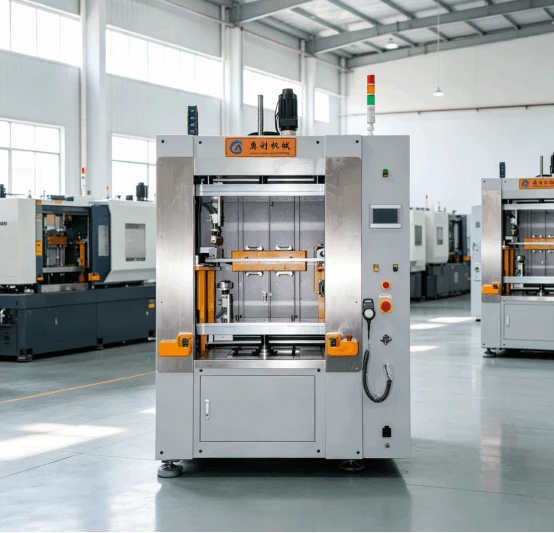
Aochuang Machinery's servo hot plate welding machine is highly compatible with the melting characteristics of PP and is specifically designed to address these welding challenges.
First, precise temperature control matches the PP melting range. The standard melting point of PP is approximately 160–170°C. The hot plate welding machine uses PID precise temperature control to fully melt the surface layer of the plastic without overheating the material and causing carbonization or blackening, while also preventing insufficient heating and weak welds. This helps preserve the original corrosion resistance, low-temperature resistance, and toughness of PP.
Second, static pressure minimizes deformation. Considering the relatively soft nature of PP, the hot plate welding machine allows the welding pressure to be adjusted for controlled and gentle compression. This helps prevent deformation caused by excessive pressure. After compression, the molten PP molecules can fully penetrate and fuse together, with weld strength reaching more than 80% of the original PP material strength.
Third, environmentally friendly welding with no residue. The entire process requires no adhesive or additives and uses pure physical thermal fusion. The welding process produces no adhesive residue or harmful substances, making it suitable for applications such as food containers, drinking water tanks, and medical PP components where environmental and material safety requirements are important.
Fourth, it is suitable for large PP workpieces. Many PP products are large structural components, such as logistics pallets and large water storage tanks. The hot plate welding machine can be equipped with customized large-size heating plates to complete full-surface welding in a single operation, minimizing joints and gaps while providing reliable waterproofing and load-bearing performance.
For many factories experiencing high PP welding defect rates, the problem is not necessarily the equipment-it may be the choice of welding process. For PP plastic components of different sizes and structures, Aochuang Machinery's servo hot plate welding machine provides a targeted welding solution. With the right process and parameters, it can achieve strong, sealed, and visually clean welds, helping manufacturers overcome long-standing PP welding challenges.


