

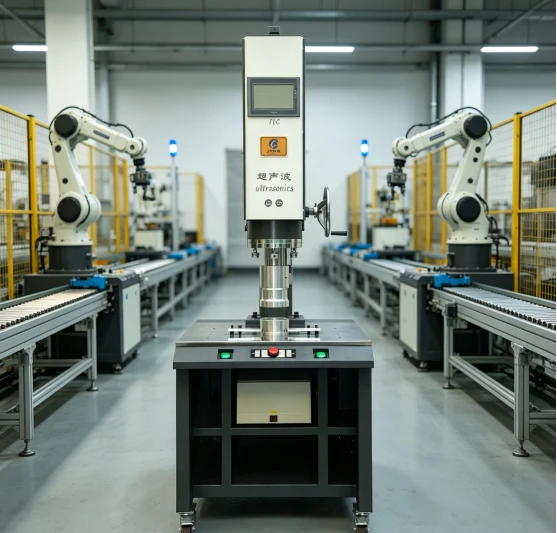
I. Core Principle Overview
Ultrasonic welding applies high-frequency mechanical vibration; the horn (sonotrode) transmits vibrational energy to the plastic contact surfaces, where friction generates heat that melts the interface and fuses the parts under pressure. Frequency determines the vibration amplitude, energy density, weldable materials, and product size, making it the first priority in machine selection.
General industry rule: the higher the frequency → the smaller the amplitude, the lower the energy density, and the better fit for small / thin-walled parts; the lower the frequency → the larger the amplitude and the stronger the energy, suited to large, thick-walled, and hard-to-melt materials.
II. Common Frequency Ranges and Basic Applications
表格
| Frequency | Typical Power | Amplitude Characteristics | Suitable Products | Not Suitable For |
|---|---|---|---|---|
| 40 kHz | Low power, 300–800 W | Smallest amplitude, low vibration stress | Micro plastic parts, thin-walled parts, sensor housings, small connectors, thin film pieces; precision small parts that must not be cracked | Thick parts, glass-fiber reinforced plastics, large-area welding, products requiring large weld volume |
| 30 kHz | 500–1200 W | Medium-small amplitude; balances precision and strength | Small-to-medium plastic parts, wire-harness sheaths, small housings, sensor plastic assemblies - balances precision and weld depth | Large-size, thick-walled, highly filled modified plastics |
| 20 kHz | 1000–3000 W (most mainstream) | Medium amplitude, balanced energy | The majority of conventional plastic housings, larger plastic parts, PP / ABS / PBT enclosures; sensor main housings - the most commonly used frequency in ultrasonic welding | Very thin, fragile parts - risk of cracking internal magnetic cores and precision components |
| 15 kHz | 2000–5000 W | Large amplitude, strong impact force | Thick-walled parts, large-area welding, glass-fiber reinforced plastics, hard thick plastics, large housings | Precision small parts and parts with internal magnetic plates / coils / thin fragile elements - high risk of damaging internal components |
III. Core Selection Logic (check in order)
1. Product size and weld area
Smaller weld area / smaller parts: prefer higher frequency (30/40 kHz). High-frequency horns can be made smaller, with less vibration attenuation and less impact on surrounding structures.
Large weld area / large products: prefer 20 kHz or 15 kHz. Lower frequency delivers higher total energy for more stable large-area fusion; however, low-frequency horns are larger and resonance control is more difficult.
Reference thresholds:
< 20 mm small plastic parts → 30 kHz / 40 kHz
20–80 mm conventional housings → 20 kHz (industry first choice)
> 80 mm large housings and long weld seams → 15 kHz / 20 kHz high power
2. Material type (critical)
Amorphous plastics (PP, PE): wide melting range, require more energy → prefer the lower 20 kHz; large-area PP housings can use 15 kHz.
Crystalline plastics (POM, PA6, PA66, PBT): sharp melting point, need concentrated energy → prefer 20 kHz; glass-fiber reinforced grades are recommended at 20 kHz or 15 kHz - the higher the glass-fiber content, the greater the need for high amplitude at low frequency.
ABS / PC / PS: amorphous, easy to weld; small parts use 30/40 kHz, large parts 20 kHz.
Brittle materials or parts with precision internal components (magnetic plates, coils, thin magnetic cores): raise the frequency as much as possible to lower amplitude and reduce vibration transmitted into the interior, avoiding cracked magnetic plates, de-soldered coils, and degraded magnetic performance.
3. Wall thickness and thin-walled / fragile structures
Thin walls < 1.5 mm, cantilevered ribs, thin ribs, or embedded precision components: choose high frequency (30/40 kHz) - low amplitude reduces the risk of cracking.
Wall thickness ≥ 2 mm, solid thick walls, no delicate internal parts: 20 kHz / 15 kHz.
4. Weld requirements: weld depth, appearance, flash control
Shallow fusion only, high appearance requirements, no flash allowed: high frequency, low amplitude, gentle energy.
Deep fusion, high-strength hermetic sealing: 20 kHz as the primary choice; hermetic welding demands uniform fusion, and 20 kHz offers the widest process window.
5. Tooling and horn limitations
The higher the frequency, the smaller the maximum horn size that can be made. A 40 kHz horn cannot be made very large; a 15 kHz horn can be large, but it is heavy and requires higher machine-frame rigidity.
If the product is too large to design a high-frequency resonant horn, the only option is to step down to 20 kHz or 15 kHz.
IV. Selection Risk Points
Low frequency on small parts: excessive amplitude cracks internal magnetic cores and thin walls, creating hidden micro-cracks that cause leaks in hermeticity tests.
High frequency on large parts: insufficient energy → weak/cold welds (虚焊), insufficient pull strength, extremely narrow and unstable process window.
Glass-fiber filled materials forced onto 40 kHz: insufficient energy, large weld-strength fluctuation, low yield.
Never reuse old parameters after changing frequency: when the frequency changes, amplitude, pressure, and hold time must all be re-validated through DOE (Design of Experiments).
V. Simplified Selection Decision Flow (quick check)
Does the product contain precision magnetic plates / coils / thin fragile parts?
Yes → prefer 30 kHz (small parts) / 20 kHz (medium-large parts); avoid 15 kHz
No → check size:
Small parts < 20 mm: 30 / 40 kHz
Conventional housings 20–80 mm: 20 kHz
Large thick housings, glass-fiber reinforced large areas: 15 kHz
VI. Supplementary: Frequency ≠ Power
Frequency is the number of vibrations per second; power is the magnitude of energy output.
At the same frequency, energy can be tuned through power levels and amplitude levels; simply raising power cannot replace the large amplitude of low frequency.


