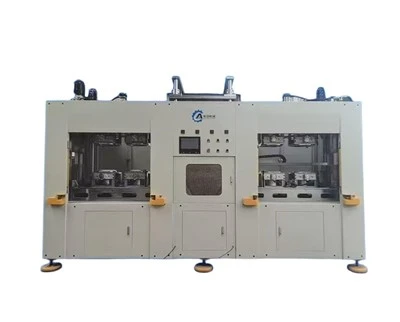
Hey there! I'm a supplier of Hot Plate Welding solutions, and today I want to dig into a question that often pops up: Can hot plate welding be used for micro - parts?
Let's start by getting a clear understanding of what hot plate welding is. Hot Plate Welding is a process where two plastic parts are heated by a hot plate until the surfaces become molten. Then, the hot plate is removed, and the two parts are pressed together, forming a strong bond as they cool. You can learn more about it on this page: Hot Plate Welding.
Now, when it comes to micro - parts, things get a bit more tricky. Micro - parts are those tiny components that are often used in industries like electronics, medical devices, and automotive sensors. These parts are usually very small, sometimes even less than a millimeter in size.


One of the main advantages of hot plate welding is its ability to create a strong and reliable bond. The heat from the hot plate melts the plastic surfaces, and when they are pressed together, the molecules intermingle, forming a solid joint. This is great for ensuring the durability of the final product. But can this process be effectively applied to micro - parts?
Advantages of Using Hot Plate Welding for Micro - Parts
Precision Bonding
Hot plate welding can offer a high level of precision. The heat distribution on the hot plate can be controlled, which means that even for micro - parts, you can ensure that the right amount of heat is applied to the surfaces to be welded. This precision is crucial because micro - parts are often very delicate, and too much heat can damage them, while too little heat won't create a proper bond.
Strong Joints
Just like with larger parts, hot plate welding can create strong joints in micro - parts. The resulting bond can withstand mechanical stress, which is important in applications where the micro - parts need to function in a harsh environment. For example, in medical devices, the joints need to be strong enough to ensure the proper functioning of the device and to prevent any leakage.
Compatibility with Different Plastics
Hot plate welding is compatible with a wide range of plastics. This is a big plus when dealing with micro - parts because different industries may use different types of plastics. Whether it's ABS, polycarbonate, or polyethylene, hot plate welding can be used to join these materials. You can find more details about the machines used in this process on the Hot Plate Welder page.
Challenges of Using Hot Plate Welding for Micro - Parts
Heat Management
As I mentioned earlier, micro - parts are very delicate. Controlling the heat precisely is a challenge. If the hot plate is too hot, it can cause the micro - parts to warp, melt unevenly, or even burn. On the other hand, if the heat is too low, the bond won't be strong enough. This requires a high - level of control over the hot plate temperature and the welding time.
Handling Micro - Parts
Micro - parts are difficult to handle. They are so small that it can be challenging to position them accurately on the hot plate. Any misalignment can result in a poor - quality weld. Specialized fixtures and handling equipment may be required to ensure that the micro - parts are placed correctly for welding.
Cycle Time
The welding cycle time for micro - parts can be longer compared to larger parts. This is because the heat needs to be carefully controlled, and the parts need to be cooled slowly to ensure a proper bond. Longer cycle times can reduce the overall productivity, which is a concern for mass - production environments.
Solutions to Overcome the Challenges
Advanced Temperature Control
Modern Hot Plate Plastic Welding Machine come with advanced temperature control systems. These systems can monitor and adjust the temperature of the hot plate in real - time, ensuring that the right amount of heat is applied to the micro - parts. This helps to prevent over - heating and under - heating, resulting in high - quality welds.
Precision Fixturing
Specialized fixtures can be designed to hold the micro - parts in place during the welding process. These fixtures can ensure accurate positioning, reducing the risk of misalignment. Some fixtures are even adjustable, allowing for different types of micro - parts to be welded.
Automation
Automation can play a crucial role in hot plate welding of micro - parts. Automated systems can handle the parts, position them on the hot plate, and control the welding process. This not only improves the accuracy but also increases the productivity by reducing the cycle time.
Real - World Applications
In the electronics industry, micro - parts such as connectors and sensors are often welded using hot plate welding. The strong and reliable joints created by this process ensure the proper functioning of these components. In the medical field, micro - parts used in devices like insulin pumps and diagnostic equipment are also welded using hot plate welding. The precision and strength of the welds are essential for the safety and effectiveness of these medical devices.
Conclusion
So, can hot plate welding be used for micro - parts? The answer is yes, but it comes with its own set of challenges. With the right technology, such as advanced temperature control, precision fixturing, and automation, hot plate welding can be a viable option for welding micro - parts.
If you're in the market for hot plate welding solutions for your micro - parts, I'd love to have a chat with you. Whether you're looking to improve your current welding process or start a new project, I can offer you the expertise and high - quality equipment you need. Don't hesitate to reach out and start a conversation about your specific requirements.
References
- Smith, J. (2020). Plastic Welding Technologies. New York: Plastic Press.
- Johnson, A. (2019). Micro - Manufacturing Processes. London: Manufacturing Books.