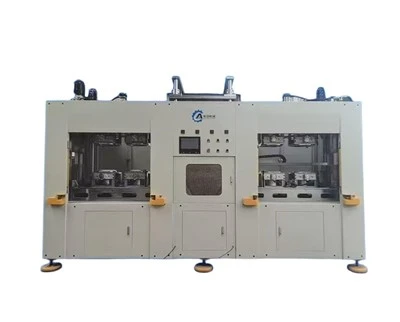
Hey there! As a supplier of Servo Hot Plate Welders, I often get asked how these machines ensure consistent welding quality in long - term production. Well, let's dive right into it.
Understanding the Basics of Servo Hot Plate Welders
First off, what's a Servo Hot Plate Welder? It's a piece of equipment that uses a heated plate to melt the surfaces of two plastic parts. Once the plastic is melted, the parts are pressed together, creating a strong and durable bond. These welders are used in a wide range of industries, from automotive to consumer goods, because they can handle different types of plastics and complex part geometries.
One of the key features of a Servo Hot Plate Welder is its servo - driven system. Unlike traditional pneumatic or hydraulic systems, servo systems offer more precise control. They can adjust the speed, force, and position of the welding process with high accuracy. This precision is crucial for maintaining consistent welding quality over long - term production runs.
Precise Temperature Control
Temperature is a critical factor in plastic welding. If the temperature is too low, the plastic won't melt properly, resulting in a weak bond. If it's too high, the plastic can degrade, causing cosmetic and structural issues. Our Servo Hot Plate Welders are equipped with advanced temperature control systems. These systems use sensors to monitor the temperature of the hot plate in real - time.
The temperature control system can make adjustments on the fly. For example, if the ambient temperature changes or if there are fluctuations in the power supply, the system can compensate by increasing or decreasing the heat output. This ensures that the plastic parts are always melted at the optimal temperature, leading to consistent welding quality.
Force and Pressure Management
Another important aspect of welding quality is the force and pressure applied during the welding process. In long - term production, it's essential to maintain a consistent force to ensure that the melted plastic parts bond properly. Our Servo Hot Plate Welders use servo motors to control the force and pressure.
The servo motors can be programmed to apply a specific amount of force at different stages of the welding process. For instance, during the melting phase, a lower force may be applied to prevent the plastic from deforming. Once the plastic is melted, a higher force is applied to create a strong bond. This ability to precisely control the force and pressure helps to ensure that each weld is of the same high quality, even after thousands of cycles.
Repeatability and Consistency
In long - term production, repeatability is key. Our Servo Hot Plate Welders are designed to perform the same welding process over and over again with minimal variation. The servo - driven system allows for accurate positioning of the parts and the hot plate. This means that each weld is made in the exact same location and with the same parameters.
The machines also have a high - speed operation, which helps to increase productivity. However, the speed doesn't come at the cost of quality. The servo system can maintain the same level of precision even at high speeds. This ensures that the welding quality remains consistent throughout the entire production run.
Quality Assurance and Monitoring
To further ensure consistent welding quality, our Servo Hot Plate Welders are equipped with quality assurance and monitoring systems. These systems can detect any issues during the welding process, such as incorrect temperature, force, or position.
For example, some of our welders have vision systems that can inspect the welds in real - time. These systems can detect defects such as cracks, voids, or uneven welds. If a defect is detected, the machine can automatically stop the production process and alert the operator. This helps to prevent defective parts from being produced and ensures that only high - quality products are delivered.
Compatibility with Different Plastics
Different plastics have different melting points and properties. Our Servo Hot Plate Welders are designed to be compatible with a wide range of plastics, including polypropylene, polyethylene, and ABS. The temperature control system can be adjusted to suit the specific requirements of each plastic.
This flexibility is important in long - term production, as it allows manufacturers to use different types of plastics without having to invest in multiple welding machines. It also ensures that the welding quality remains consistent, regardless of the type of plastic being used.
Training and Support
As a supplier, we understand that proper training and support are essential for ensuring consistent welding quality. We offer comprehensive training programs for our customers, which cover everything from machine operation to maintenance.


Our technical support team is also available 24/7 to assist with any issues that may arise. Whether it's a problem with the temperature control system or a question about the welding process, our team is always ready to help. This support helps to ensure that our customers can get the most out of their Servo Hot Plate Welders and maintain consistent welding quality in long - term production.
Conclusion
In conclusion, our Servo Hot Plate Welders are designed to ensure consistent welding quality in long - term production. With precise temperature control, force and pressure management, repeatability, quality assurance, compatibility with different plastics, and excellent training and support, we can help you achieve high - quality welds every time.
If you're in the market for a reliable and high - performance welding solution, consider our Servo Hot Plate Welders. You can learn more about our Hot Plate Plastic Welding Machine, Infrared Hot Plate Welding Machine, and Hot Plate Welding Equipment on our website. If you have any questions or would like to discuss your specific requirements, don't hesitate to reach out. We're here to help you take your production to the next level.
References
- Smith, J. (2020). Plastic Welding Technology. Wiley.
- Brown, A. (2019). Advanced Welding Techniques for Plastics. Elsevier.