

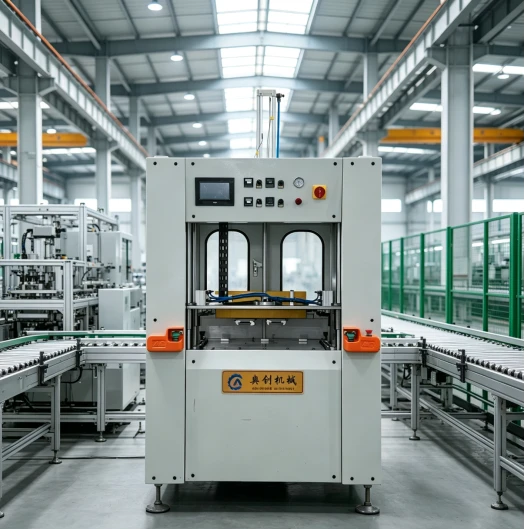
Full Landscape of Hot Melt Machine Applications in the Automotive Industry at Aochuang Machinery
Aochuang Machinery hot melt machine: uses a heating head to heat and soften the rivet posts pre-formed on plastic parts, presses them into the shape of a rivet head, and after cooling turns the edge over to clamp and fix another layer of material (fabric, nonwoven, metal part, PCB or decorative panel).
1. Process Comparison
|
Comparison |
Hot plate welding / spin welding |
Hot riveting machine |
|
Parts joined |
Two plastic parts fused into one |
Plastic rivet posts turned over to clamp the joined part |
|
Typical result |
Sealed weld seam |
Mechanical fastening plus local hot melting |
|
Common applications |
Kettles, housings, headlamps |
Interior wrapping, bracket fixing, insert pressing |
|
Sealing required |
Yes |
Generally not required; pull-out force is required |
2. Automotive Application Map (Interior Trim as the Absolute Main Force)
|
Part |
Typical joined parts |
Materials |
Process points |
|
Door panel assembly |
Map pockets, armrests, impact blocks, sound insulation felt and trim strips riveted to the door panel frame |
PP, ABS, PC/ABS, TPO |
Multi-point simultaneous riveting; the rivet head must not damage the visible surface; typically 10 to 30 rivet points |
|
Instrument panel / centre console frame |
Air ducts, trim panels, brackets and wiring harness clips fixed |
PP+GF, ABS |
Frame combined with skin or nonwoven; rivet points hidden at the back |
|
A/B/C pillar trims |
Sound insulation cotton and trim panels riveted to the frame |
PP, TPO, nonwoven |
Thin-wall parts; excessive pressure easily causes whitening or cracking |
|
Seat back panel / seat frame |
Back panels, protective panels and pockets fixed |
PP, PA |
Many rivet points; often equipped with multi-head independently temperature-controlled stations |
|
Headliner / sound insulation felt / floor mats |
Nonwoven and felt mats combined with plastic frames |
PP, PET felt |
Low temperature to prevent sticking and avoid burning through the fabric |
|
Exterior: bumpers, grilles, badges, spoiler brackets |
Brackets, nameplates and trim strips fixed |
PP+GF, ABS |
No indentation or heat marks allowed on the visible surface |
|
Lamp interior |
Reflector bowls, brackets and decorative rings riveted |
PC, ABS |
Small rivet points requiring precise temperature control |
|
Automotive electronics / PCB brackets |
Circuit boards, connectors and sensor housings fixed |
PA, PBT, PC |
Low temperature and low pressure to avoid damaging electronic components |
|
New energy parts |
Battery tray cover plates, charging port flaps and harness brackets |
PP, PA |
Newly added applications requiring stable heat resistance and pull-out force |
Door panels, instrument panels, A/B pillar trims, seat back panels, centre console brackets and PCB brackets are the six main battlegrounds of hot riveting in interior trim; exterior bumpers, grilles, badges and charging port covers also have matching applications.
3. Why Interior Assembly Increasingly Uses Hot Riveting
Substitution path: screws to ultrasonic riveting or vibration friction, and then to servo hot riveting. The core drivers are:
Cost: no screws, no nuts and no glue, saving one round of fastener purchasing.
Rattle control: interior trim must not develop loose rattles after long-term vibration; hot riveting is a plastic turn-over that loosens less easily than screws.
Dissimilar materials can be pressed: metal inserts, nonwoven, fabric and PCB can be pressed directly onto the plastic frame, which ultrasonic welding cannot do.
Appearance friendly: rivet points sit at the back or in hidden positions, leaving no mark on the visible surface.
Flexibility: servo models can store multiple recipes, and a model change only requires changing the rivet head and parameters, which suits multi-variety small-batch interior lines.
Traceability: temperature, press displacement and pressure of every point can be recorded, meeting the process traceability requirements of IATF 16949.
4. Process and Equipment Forms
4.1 Heating methods (three generations)
Constant-temperature hot plate type: the rivet heads are heated as a whole; simple and inexpensive, but the temperature fluctuates widely and light-coloured parts are easily scorched.
Pulse hot riveting: heated instantly when power is applied and cooled when it is cut off; the rivet head temperature is controllable and the appearance quality is good.
Servo pressing plus independent temperature control: each rivet head has its own closed-loop temperature control, while press displacement and pressure are servo-controlled; this is the mainstream configuration on automotive interior lines today.
4.2 Key parameters
Rivet head temperature: about 220 to 280 C for ABS and PC, about 180 to 240 C for PP and PE, and higher for PA.
Press displacement: determined by the rivet post diameter; the turned-over edge height is generally 0.8 to 2 mm.
Holding and cooling: after pressing, the rivet head stays in place until the plastic sets before lifting, to prevent spring-back.
Multi-point stations: each rivet head is independently temperature-controlled, avoiding a point that is overheated and burnt through while another point is falsely riveted.
4.3 Common defects
False riveting or insufficient pull-out force: temperature too low, pressure too low, or rivet post length insufficient.
Whitening or cracking: pressure too high, insufficient cooling, or an eccentric rivet head.
Scorching or yellowing: temperature too high or holding time too long.
Heat marks on the visible surface: heat leakage from the rivet head or inadequate insulation.
Felt or fabric burnt through: temperature too high or pressing time too long.
4.4 Equipment form spectrum
|
Form |
Application |
Cycle time / cost |
|
Single-point handheld hot riveting gun |
Repair welding, small batches, after-sales |
Low, manual operation |
|
Multi-head frame-type hot riveting machine |
Fixed parts such as door panels and seat back panels, 10 to 30 rivet points |
Medium, mainly single machines |
|
Servo hot riveting workstation |
Tier 1 mass production lines, with displacement and pressure closed loops and parameter storage |
Medium to high |
|
Turntable / multi-station automatic line |
Robotic loading and unloading plus in-line inspection and traceability |
High, complete line delivery |
5. Development Trends
From single-point equipment to complete stations: hot riveting, tooling positioning, pull-out force sampling and parameter traceability are delivered as a package, and stand-alone machines no longer command a good price.
Servo replacing pneumatic: displacement and pressure closed loops are the threshold for entering Tier 1 supplier audits.
Lighter interiors and multi-material composites: parts combining skin, frame, felt and metal inserts are increasingly common, and hot riveting is one of the few processes able to press dissimilar materials at the same time.
New energy interiors: larger cockpit screens and higher centre console integration increase the number of rivet points on brackets.
Upgraded appearance requirements: light-coloured interiors and fewer visible rivet points are pushing for pulse temperature control and anti-heat-mark structures.


