

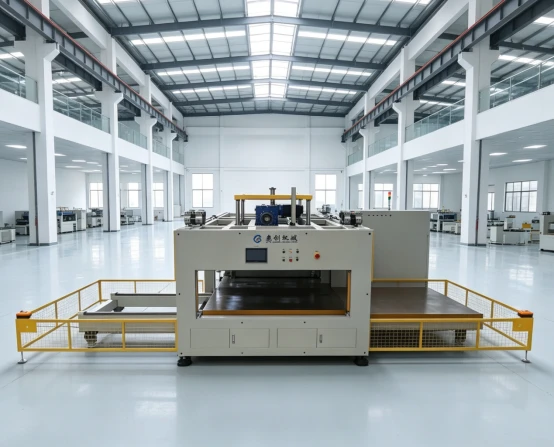
1. What the Servo Drive Changes
Pneumatic hot plate machines use "time plus a throttle valve" to approximate the speed of movement, so the actual weld depth equals the time multiplied by an unstable speed. Air pressure fluctuation, cylinder creeping and seal wear all change the weld depth directly, and the same parameter set may fail to weld through once a new batch of material is used. On a servo hot plate machine, each motion axis is driven by a servo motor through a ball screw or a rack and pinion, so position, speed and pressure all become programmable closed-loop variables. This brings four substantive changes.
First, weld depth is no longer inferred from time but reached by position, with control accuracy in the order of 0.05 to 0.1 mm; the machine switches to the next stage as soon as the displacement reaches the target value, and time serves only as overtime protection. Second, the changeover time can be set precisely and measured on site, which is the most direct means of suppressing cold welds. Third, contact and pressing can be staged at different speeds, and slow contact significantly reduces the impact on large parts and the entrainment of air bubbles. Fourth, the position, pressure and temperature curves of the whole cycle can be recorded and exported, providing a basis for process standardisation, first-article validation and batch traceability.
2. Axis Configuration and Structural Rigidity
A typical configuration has three axes: the upper pressing axis, the hot plate advance and retract axis, and the hot plate horizontal slide axis. Large table models often use left and right dual stations on the horizontal slide, so that heating and pressing run in parallel to increase output. The pressing force is calculated from the total weld rib area around the perimeter of a 1,200 mm class double-sided pallet and is usually in the range of 20 to 50 t, and it must match the rigidity of the frame.
One fact that is easily overlooked is that the elastic deformation of the frame and of the upper and lower platens is read by the displacement sensor as well. If the reinforcing ribs and support points behind the platen are insufficient, what the servo actually reads is "the frame sinking" rather than the true weld depth, and the set weld depth is never reached. Measurement should use a linear glass scale or a magnetic scale, installed as close as possible to the plane where the weld seam lies and compensated for the working temperature. Pressure control relies on load-cell or spoke-type sensors, which must be zeroed and calibrated according to the actual weight of the tooling; they must be recalibrated after every mould change, otherwise the pressure value is only nominal.
3. Parameter Setting and Curve Staging
The whole curve can be divided into three stages. Heating and contact stage: the sheet temperature is commonly 210 to 230 C for PE and 200 to 220 C for PP; the temperature difference across the platen of a large table should be kept within plus or minus 3 to 5 C; the contact pressure is about 0.1 to 0.3 MPa, and the stage ends when the displacement reaches the target weld depth, with a single-side weld depth of about 0.5 to 1.5 mm. Changeover stage: withdrawal of the hot plate and closing of the upper and lower moulds should be completed within 5 to 10 s, the shorter the better. Pressing and holding stage: approach quickly first, reduce the speed to 2 to 5 mm/s before contact, set the pressing pressure according to the actual weld rib area, usually 0.3 to 1.0 MPa, and hold until the joint has enough rigidity to be demoulded; heavy pallets often require minutes.
The core principle of staged programming is that one motion has only one main control variable: the contact stage controls speed, the heating stage controls pressure and ends on position, and the pressing stage controls pressure while also setting a displacement limit, so that multiple targets do not pull against each other and cause the curve to drift. Temperature control should use zoned PID with independent control of the edge zones and the centre zone; otherwise a large platen naturally has a temperature difference, because the edges dissipate heat faster while the centre accumulates more heat, and single-point control cannot cover the weld ribs around the entire perimeter.
4. Typical Defects and Countermeasures
Cold welding is the most concealed defect: once the changeover time is exceeded, the molten surface cools and skins over, the appearance remains complete, the knock sounds dull, and no fusion can be seen in a cut section. The countermeasure is to shorten the changeover time and include the measured value in the inspection for each shift. Over-welding appears as accumulated flash and insufficient effective rib width, mostly caused by a platen temperature that is too high or a weld depth setting that is too large; the platen temperature should be lowered and the displacement calibration checked. Misalignment comes from wear of the locating pins of the upper and lower moulds and from reduced repeat accuracy of the slide table, so the fit between pins and holes and the synchronisation of the two axes must be checked.
Local under-welding is usually not a parameter problem but rather a combination of platen temperature difference and incoming part warpage; the platen temperature distribution should be measured first, and then the flatness of the workpiece and the tooling support checked. Internal voids and de-welding are mostly caused by insufficient holding pressure or premature pressure release; the holding time should be extended and the result confirmed by cutting a section. Material sticking and stringing on the platen surface belong to ageing of the hot plate coating or locally excessive temperature, so the coating condition and the release treatment must be checked.
5. Acceptance Criteria and Daily Maintenance
Acceptance should be measured item by item with written records kept: position repeat accuracy, platen temperature distribution, the measured changeover time from hot plate withdrawal to mould closing, the calibrated pressing force, the cycle time per part, and the curve export function. The last step of process finalisation is to cut the first article and use the measured weld depth to back-calculate the displacement set value, rather than copying the supplier sample parameters, because the sample parameters correspond to another machine, another set of moulds and another batch of material.
Daily maintenance focuses on lubrication of the screws and guide rails, cleaning of the linear scale and its read head, periodic calibration of the pressure sensors, checking the flatness and coating of the hot plate, comparison of thermocouples, and functional testing of the safety interlocks, including the safety door and safety light curtain interlock and the emergency stop that triggers the servo brake and the pressure release at the same time. If any of these items fails, it will show up as "the parameters are unchanged but the weld no longer penetrates"; when troubleshooting, the condition of the equipment should be checked before the process parameters.


