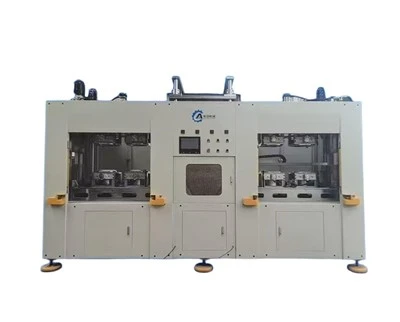
Hey there! As a supplier of Vibration Welding Systems, I've seen firsthand the importance of welding efficiency. In this blog, I'm gonna share some tips on how to improve the welding efficiency of a Vibration Welding System.
Understanding the Basics of Vibration Welding
Before we dive into the tips, let's quickly go over what vibration welding is. Vibration welding is a process that joins two plastic parts together by generating frictional heat through high-frequency vibrations. This heat melts the plastic at the joint interface, and when the vibrations stop, the parts cool and solidify, forming a strong bond.
There are different types of vibration welding, like linear vibration welding and orbital vibration welding. Each type has its own advantages and is suitable for different applications. For example, linear vibration welding is great for simple, straight joints, while orbital vibration welding can handle more complex geometries.
Selecting the Right Materials
One of the first steps to improving welding efficiency is choosing the right materials. Not all plastics are created equal when it comes to vibration welding. Some plastics have better compatibility and weldability than others.
For instance, semi-crystalline plastics like polypropylene and polyethylene tend to weld well because they have a distinct melting point. Amorphous plastics like ABS and polycarbonate also work well, but they require a bit more attention to the welding parameters.
It's also important to make sure that the materials are clean and free of contaminants. Even small amounts of dust, oil, or moisture can affect the welding quality and efficiency. So, before you start welding, give the parts a good cleaning.
Optimizing the Welding Parameters
The welding parameters play a crucial role in the efficiency of a Vibration Welding System. Here are some key parameters to consider:
Vibration Amplitude
The vibration amplitude determines how much the parts move during the welding process. A larger amplitude generally means more frictional heat is generated, which can speed up the welding process. However, if the amplitude is too large, it can cause excessive flash or damage to the parts. You need to find the right balance based on the materials and the joint design.
Welding Pressure
The welding pressure affects how well the parts are held together during the welding process. Too little pressure can result in a weak bond, while too much pressure can cause the plastic to flow out of the joint or damage the parts. You should adjust the pressure according to the size and shape of the parts, as well as the material properties.
Welding Time
The welding time is the duration for which the vibrations are applied. It needs to be long enough to melt the plastic at the joint interface but not so long that it causes overheating or degradation of the material. You can use trial and error to find the optimal welding time for your specific application.
Maintaining the Vibration Welding System
Regular maintenance of your Vibration Welding System is essential for ensuring its efficiency. Here are some maintenance tasks you should perform:
Cleaning
Keep the welding machine clean by removing any debris, dust, or plastic residue. This will prevent the build-up of contaminants that can affect the performance of the machine. You can use a soft brush or compressed air to clean the machine.
Lubrication
Some parts of the Vibration Welding System, such as the bearings and guides, may require lubrication. Make sure to use the recommended lubricant and follow the manufacturer's instructions for lubrication intervals.
Inspection
Regularly inspect the machine for any signs of wear or damage. Check the belts, pulleys, and other moving parts for proper alignment and tension. Replace any worn-out parts immediately to prevent further damage to the machine.
Training the Operators
Even the best Vibration Welding System won't be efficient if the operators don't know how to use it properly. That's why it's important to provide comprehensive training to your operators.
The training should cover the basics of vibration welding, including the different types of welding, the welding parameters, and the safety procedures. Operators should also be trained on how to set up the machine, load the parts, and monitor the welding process.
By training your operators, you can ensure that they are using the machine correctly and efficiently, which will ultimately lead to better welding results.
Using Advanced Technology
Advancements in technology have made it possible to improve the efficiency of Vibration Welding Systems. For example, some modern systems come with advanced control systems that can automatically adjust the welding parameters based on the material properties and the joint design.
These control systems can also monitor the welding process in real-time and provide feedback to the operator. This allows for quick adjustments to be made if any issues arise, which can save time and improve the quality of the welds.
Another technology that can improve efficiency is the use of robotic systems for part handling. Robots can load and unload the parts quickly and accurately, reducing the cycle time and increasing the overall productivity of the welding process.


Conclusion
Improving the welding efficiency of a Vibration Welding System requires a combination of factors, including selecting the right materials, optimizing the welding parameters, maintaining the machine, training the operators, and using advanced technology.
By following these tips, you can increase the productivity of your Vibration Welding System, reduce costs, and improve the quality of your welds. If you're in the market for a Vibration Welding System, Vibration Plastic Welder, or Vibration Welder, we're here to help. We offer a wide range of high-quality welding systems that are designed to meet your specific needs.
If you have any questions or would like to discuss your requirements further, feel free to reach out to us. We'd love to have a chat and see how we can assist you in improving your welding efficiency.
References
- "Plastic Welding Handbook" by John Doe
- "Advanced Vibration Welding Techniques" by Jane Smith