

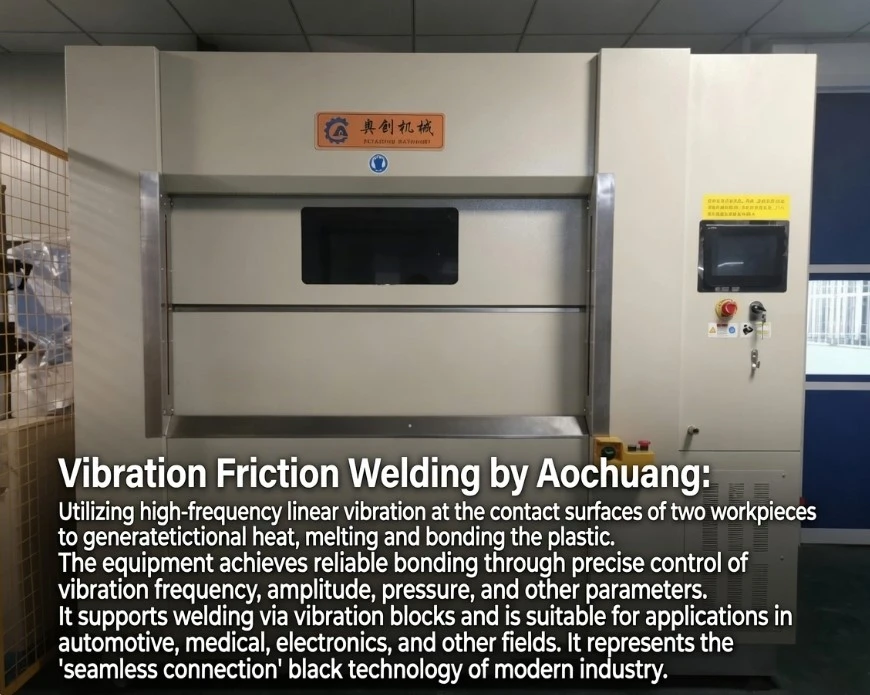
In production facilities manufacturing automotive headlights, intake manifolds, radiators, large plastic housings, and plastic parts with complex curved surfaces, countless factories have long been plagued by unsolvable pain points associated with traditional welding methods: ultrasonic welding has low load-bearing capacity, cannot handle large flat parts, fails to bond fiberglass-reinforced PP or nylon securely, and its high-frequency vibrations can shatter built-in precision components; Conventional hot-plate fusion has relatively slow melting speeds, suffers from material overflow, dimensional deviations, and poor batch consistency; adhesive bonding lacks resistance to high and low temperatures, is prone to aging and delamination, exceeds VOC limits (making it environmentally unfriendly), and has extremely low pressure resistance; rotary fusion machines are only suitable for circular workpieces and are completely incapable of processing square, irregularly shaped, or large flat surfaces. However, the Aochuang Machinery Linear Vibration Friction Welding Machine has emerged, leveraging high-frequency reciprocating linear friction welding technology to thoroughly overcome the challenges of welding large, irregularly shaped, complex curved surfaces, and high-glass-fiber-content plastics that are difficult to weld. It has become an indispensable, high-end core piece of equipment for the automotive and auto parts, new energy, home appliance, and medical industries that deal with large plastic components.
Many front-line operators use friction vibration welders daily yet fail to grasp the underlying core logic. The core principle of the friction vibration welder is extremely simple yet extremely powerful: the upper and lower workpieces are pressed tightly together; the upper die performs linear reciprocating vibrations at 120–240 Hz with low frequency and high amplitude, causing continuous, intense friction at the contact surface that instantly generates high temperatures, rapidly bringing the surface layers of the plastic to a molten, flowable state; Once the preset weld depth is reached, the vibration stops instantly, and pressure is maintained to cool and set the joint. The molecules of the upper and lower plastic parts interweave and fuse deeply, completing a permanent, integrated weld. The entire process relies on purely physical friction fusion-no adhesives or solder wires are required, and there is no high-frequency vibration. Heat is highly concentrated in the weld zone, preventing damage to internal circuit boards, precision inserts, or thin-walled structures within the workpieces. The weld strength is virtually identical to that of the base plastic material itself.
It offers comprehensive advantages over traditional processes in every aspect: Compared to ultrasonic welding, it can weld extra-large flat surfaces, irregular curved surfaces, and deep-cavity housings. It provides stable, all-around welding for hard-to-bond materials with ultra-high fill rates, such as PP + glass fiber and nylon + glass fiber, without violent impact vibrations, ensuring zero damage to internal components; Compared to hot-plate hot-melt welding, the welding speed is more than three times faster, with uniform and smooth welds, minimal material overflow, and an airtight, pressure-resistant rating up to IP69K, while maintaining batch dimensional accuracy of ±0.05 mm; Compared to rotary fusion machines, it is not limited to circular structures; it is fully compatible with square, rectangular, irregular frames, and curved surface butt joints; Compared to adhesive bonding, it is environmentally friendly and non-toxic with zero VOCs, resistant to high and low temperatures, oil, and corrosion, and remains crack- and leak-free for the lifetime of the product, fully complying with the stringent safety standards for automotive vehicles, water-contact food products, and medical devices.
From small components like automotive activated carbon canisters and headlight covers to large parts such as automotive intake manifolds over one meter in length, vehicle radiator housings, large home appliance casings, and plastic enclosures for new energy storage systems-as long as they are thermoplastic flat or irregularly shaped parts requiring butt welding, the vibration friction welding machine can complete the welding in a single pass to the highest standards. Today, industries such as new energy vehicles, automotive interior and exterior trim, automotive lighting, new energy piping, and large water purification housings are fully phasing out outdated welding processes and switching entirely to vibration friction welding. It is not merely a welding machine; it is an industrial powerhouse that drives quality upgrades, skyrocketing production capacity, drastically reduced defect rates, and significantly lower costs for large plastic products.


